
Design and installation guide
Firefighting foam: formation, families and appropriate selection
Firefighting foam is formed by introducing air into water mixed with foam concentrate at a specified ratio. On suitable Class B flammable liquids, the blanket covers the fuel surface and helps limit vapour release and reignition. Water in the foam also contributes cooling.
Selection considers concentrate family, fuel compatibility, expansion, application equipment and environmental properties as separate factors. Alongside AFFF and AR-AFFF, the Özkartay portfolio includes protein, fluoroprotein, FFFP, synthetic and NFF options, together with concentrates for Class A and training applications.
01
From concentrate to foam blanket
Concentrate, foam solution and finished foam are different stages, with distinct equipment functions at each step.
Correct proportioning with water
A proportioner introduces concentrate into water at the manufacturer ratio for the relevant fuel. The mixture is foam solution. The percentage denotes concentrate volume in the solution; a universal 3% or 6% setting is not suitable for every product.
Air and expansion
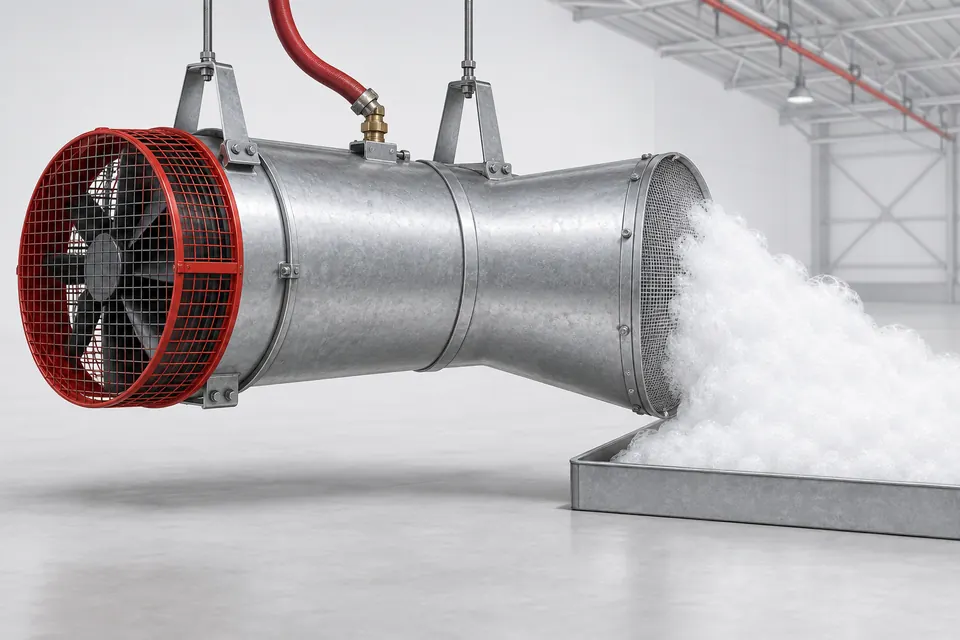
A branchpipe, nozzle, sprinkler or generator introduces air into the solution. CAFS uses a controlled compressed-air arrangement. Expansion is the volume of finished foam divided by the solution volume: 20:1 means twenty volumes of foam from one volume of solution.
Protection at the fuel surface
A suitable Class B blanket helps limit fuel contact with air and vapour release. An aqueous film on suitable hydrocarbons contributes to AFFF performance, while a protective polymer layer contributes to some alcohol-resistant products on polar solvents.
Maintaining the blanket
Application density, duration, fuel temperature, delivered flow and drainage are considered together. Wind, obstructions or forceful contact with fuel can affect the blanket. Extinguishment and burnback resistance depend on the selected product and its application conditions.
02
Three distinct assessments for appropriate foam selection
A family name alone does not establish validated fuel and equipment combinations. Product data, test scope and site conditions are considered together.
Fuel and purpose
- Hydrocarbons and polar solvents
- Hydrocarbons such as gasoline and diesel differ from water-miscible alcohols or ketones. For polar solvents, an alcohol-resistant product is checked against the actual fuel. Blended fuels require more than selection by a generic fuel name.
- Class A, CAF and training
- Class A concentrates improve wetting on suitable solid combustibles. CAFS is a foam-generation method, with Class A or B use determined by the chosen concentrate. Training foam supports equipment and personnel exercises without automatically representing an operational agent performance.
Expansion and hardware
- Low, medium and high expansion
- Expansion is generally classified as low up to 20:1, medium above 20:1 up to 200:1, and high above 200:1. Low expansion serves surface applications, while medium and HI-EX high expansion are assessed for suitable area or enclosure protection. Concentrate and hardware determine the actual result.
- Proportioner, water and discharge device
- Viscosity, flow range and residual pressure affect proportioning accuracy. Fresh, sea, brackish or hard-water suitability varies by product. Tanks, pumps, branchpipes, sprinklers and generators are matched to the concentrate validated combinations and hydraulic design.
Documentation and lifecycle
- Reading the test scope
- EN 1568 has different parts for expansion and fuel type; UL and FM assessments also depend on particular hardware and application conditions. ICAO aviation performance and GreenScreen environmental assessment are separate subjects. One approval does not establish every other performance or application.
- Storage, maintenance and environment
- Temperature, packaging and tank materials follow the product instructions, with sampling used to monitor concentrate condition. PFAS and biodegradability statements for NFF / F3 / SFFF are tied to model documentation. Fluorine-free products also require controlled collection and management after use.
03
Foam selection for the hazard area
Tank areas, solvent storage and solid-material zones within the same facility may require different products or application methods.
Fuel and tank areas
- Protected hazard
- Fuel type, storage configuration and surface area are central inputs.
- Selection approach
- Fuel-validated concentrate, discharge hardware, density and duration are selected together.
Paint and chemical production
- Protected hazard
- Water-miscible solvents and chemical blends may be present.
- Selection approach
- Alcohol resistance and NFF options are assessed for the actual fuel, with existing equipment compatibility verified.
Hangars, warehouses and solid combustibles
- Protected hazard
- Surface fires, large enclosures and Class A materials create different requirements.
- Selection approach
- Expanded foam, a specialist concentrate selected for the combustible material and a suitable system arrangement are established.
04
Foam families and application purposes
Scroll the table horizontally to view every column.
| Family / purpose | Distinguishing feature | Selection check |
|---|---|---|
| AFFF / AR-AFFF | Fluorinated surfactants; compatible alcohol resistance in AR models. | Fuel, concentration, equipment and environmental conditions. |
| Protein / FP / FFFP | Protein-based blanket; fluorinated ingredients in FP and FFFP. | Aspiration, fuel and any AR scope. |
| Synthetic / HI-EX | Expansion options with suitable concentrate and generators. | Enclosure, air source, fill time and tested arrangement. |
| NFF / F3 / SFFF | Products formulated without intentionally added fluorinated chemistry. | Model fuel and hardware scope; transition and cleaning plan. |
| Class A / CAF | Wetting applications and compressed-air foam production. | Material, concentrate and air–solution arrangement. |
| Training foam | Special formulation for personnel and equipment exercises. | Training objective, equipment behaviour and waste management. |
Share the fuel or material, current concentrate and equipment so we can assess the appropriate family, model and application method together.