
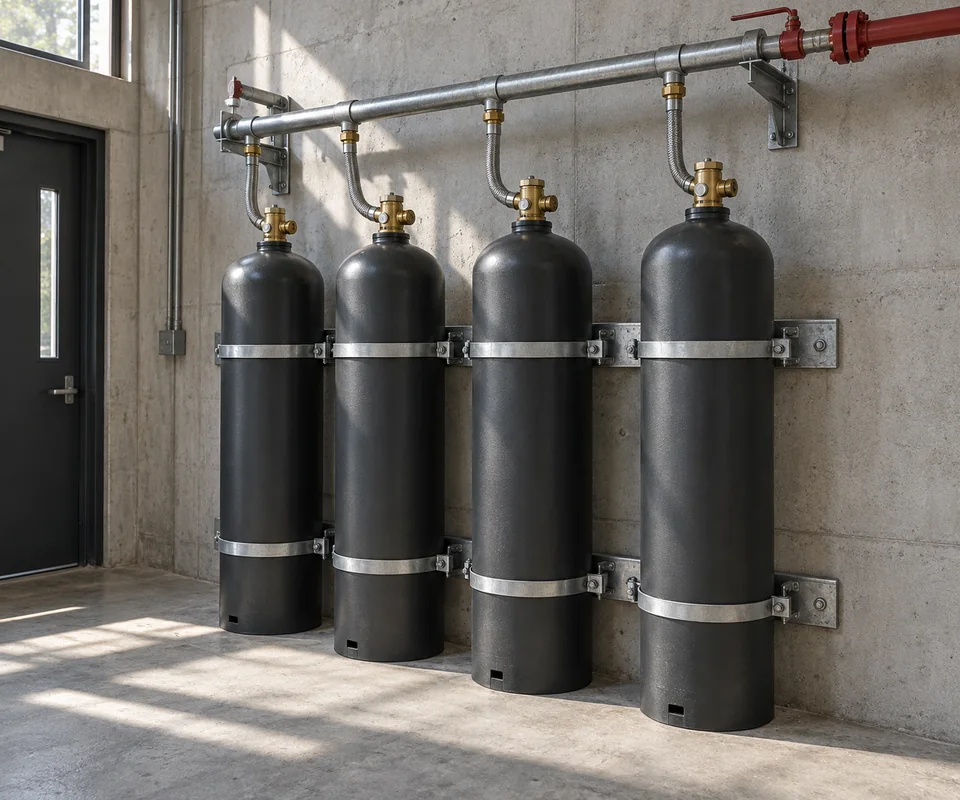
Design and installation guide
Protection for sensitive spaces: a guide to gaseous suppression systems
Water, powder or foam discharge can cause additional damage in spaces containing sensitive electronics or historical archives. Gaseous suppression systems address these protection needs with electrically non-conductive agents that leave no solid agent residue after discharge. The aim is to suppress fire at an early stage while reducing the impact of the intervention on equipment and operations.
Özkartay gaseous suppression solutions are designed by assessing the protected enclosure, fire risk, human access, equipment sensitivity and ventilation together. The detection panel, detectors, cylinders, control valves, pipework and nozzles are designed as one system. Total flooding of an enclosure and local application to specific equipment have different requirements and are assessed separately.
01
Operating principles and engineering design
The suppression mechanism depends on the agent. Agent quantity, design concentration, discharge time, enclosure integrity and life safety are verified against the selected system manufacturer data and the standards applicable to the project.
Heat absorption
Chemical clean agents such as FK-5-1-12 and HFC-227ea absorb heat in the combustion zone to help interrupt the fire. Flow calculations verify the time needed to reach the target concentration. A 10-second discharge target in some halocarbon systems does not mean every gaseous agent discharges in the same time.
Oxygen reduction
Inert gases reduce the oxygen concentration in the protected enclosure to the design level at which combustion cannot continue. A low-oxygen atmosphere is not unconditionally safe: concentration, exposure time, enclosure conditions and evacuation are assessed together. CO₂ requires a separate life-safety assessment because of its own physiological effects in addition to oxygen reduction.
Enclosure integrity and door-fan testing
Total-flooding designs assess leakage through walls, ceilings, doors and cable penetrations, with relevant openings sealed appropriately. A door-fan test helps assess whether the enclosure can retain the required protection level for the specified hold time. Hold time and acceptance criteria come from the project standard appropriate to the agent and fire scenario.
Pressure relief and ventilation
Positive or negative pressure caused by discharge is assessed against the enclosure structural limits and system flow characteristics. A pressure-relief vent is sized where required. The project defines ventilation, door and opening controls, together with post-discharge ventilation and safe re-entry arrangements.
Cross-zone detection and release sequence
Cross-zone detection or confirmed alarm logic can reduce unwanted releases. Detector type, alarm confirmation between detection zones, pre-discharge warnings and release delay are selected for the fire risk, evacuation needs and control system. The approved control sequence defines the alarm conditions that initiate discharge.
Manual controls, evacuation and access safety
Manual release, safe maintenance isolation and an abort function where permitted by the system are arranged according to the approved control sequence. An abort button is not a common solution for every gaseous system. CO₂ applications require particular attention to pre-discharge warnings, evacuation, controlled access and re-entry procedures.
02
Agent types and selection criteria
Agent selection considers enclosure volume, fire load, human access, integrity, cylinder space and environmental objectives together. The following families explain general design options; the final product, manufacturer, supply and approval scope are established separately for the project.
FK-5-1-12 clean agent
- Properties and operating principle
- An electrically non-conductive clean agent stored as a liquid and applied through vaporisation during discharge. It suppresses fire primarily through heat absorption and leaves no solid agent residue.
- Environmental characteristics and product name
- A fluoroketone with zero ozone-depletion potential and low global-warming potential. FK-5-1-12 is the agent designation; Novec 1230 is a trade name associated with this agent. Manufacturer, filling source and system compatibility are verified using the selected product documentation.
- Occupancy and equipment assessment
- Considered for data centres, archives and spaces containing sensitive equipment. Suitability for occupied spaces is verified against design concentration, exposure limits and evacuation arrangements. Material compatibility, discharge effects and restart conditions are also part of the design.
HFC-227ea / FM-200
- Properties and operating principle
- A colourless, odourless and electrically non-conductive halocarbon clean agent. Its suppression effect is primarily based on heat absorption. HFC-227ea, also known by the FM-200 trade name, is applied without leaving solid agent residue when the system is correctly designed.
- Storage and discharge design
- Cylinder space, agent quantity, filling density and pipe routing are assessed together. Liquid storage can provide a compact arrangement in some projects; cylinder count and discharge time are determined by enclosure volume and manufacturer flow calculations.
- Selection and life safety
- Considered for server rooms, control centres and enclosures containing electronics. Occupied-space use is assessed against concentration and exposure limits, while environmental objectives and applicable supply conditions are considered during agent selection.
Inert gases: IG-541, IG-55, IG-100 and IG-01
- Agent compositions
- IG-541 is a mixture of nitrogen, argon and CO₂. IG-55 combines nitrogen and argon; IG-100 is nitrogen; IG-01 is argon. Inert agents do not all have the same composition and are not all described by the Inergen name.
- Operating principle and storage
- Suppresses fire by reducing oxygen concentration and leaves no solid agent residue. Stored as compressed gas in high-pressure cylinders. Depending on the system, nominal storage options such as 200 or 300 bar are available; pipework pressure, regulation and discharge time are separate design parameters.
- Enclosure and evacuation conditions
- Can be considered for archives, museums and larger enclosures. Cylinder space, pipe distance, pressure relief and acoustic effects on sensitive equipment are checked together. Occupied-space suitability is verified against oxygen concentration and permitted exposure time, with evacuation following the alarm.
Carbon dioxide / CO₂
- Operating principle and application
- An electrically non-conductive gas that contributes to suppression through thermal effects and oxygen reduction. It can be designed for total flooding or local application to suitable industrial hazards and leaves no solid agent residue.
- High- and low-pressure options
- Options include high-pressure cylinders and low-pressure refrigerated storage. Storage pressure depends on temperature and system arrangement. Cylinder, tank and discharge data come from the selected system technical documentation, with reference temperature and storage conditions defined in the project.
- Life safety and controlled access
- CO₂ at extinguishing concentrations is dangerous to life and is not presented as a safe alternative to clean agents in occupied spaces. Application is considered only with dedicated safety design in areas unoccupied during discharge, with controlled access and evacuation. Maintenance lockout, pre-discharge warnings, evacuation and re-entry conditions are defined together.
03
Solutions by facility and application
The following examples show starting points for agent selection. The final solution is established after verifying the fire scenario, human access, enclosure integrity and equipment compatibility.
Data centres and server rooms
- Protection needs
- Sensitive server equipment, high electrical loads and operational continuity needs.
- Project-specific solution
- FK-5-1-12, HFC-227ea or suitable inert-gas solutions are assessed. Suspended ceilings, raised-floor voids, ventilation control, pressure relief and discharge effects on equipment are considered together. Any required cabinet or panel protection is planned separately within its own design scope.
Museums, archives, libraries and art galleries
- Protection needs
- Documents, collections and historical artefacts sensitive to water or solid agent residue.
- Project-specific solution
- Clean-agent options such as inert gases or FK-5-1-12 are assessed. Material compatibility, fire depth, shelving, enclosure integrity and required hold time are checked. Collection protection and evacuation of visitors and staff are designed together.
Electrical distribution, transformer and switchgear rooms
- Protection needs
- Electrical arc risk, equipment density, ventilation openings and maintenance access.
- Project-specific solution
- Non-conductive agents are assessed for the electrical and equipment conditions. CO₂ is considered only for suitable industrial hazards with dedicated safeguards that ensure no personnel are present during discharge. HFC-227ea or inert-gas selection is also verified through enclosure, leakage and life-safety calculations.
Pharmaceutical, medical and cleanroom facilities
- Protection needs
- Controlled environments, hygiene requirements and the need to reduce product and equipment contamination.
- Project-specific solution
- FK-5-1-12 or suitable inert-gas solutions are assessed against the process, material compatibility and personnel safety. Cleanroom pressure balance, ventilation interlocks and post-discharge restart conditions are engineered together; agent selection alone does not guarantee sterility.
04
Gaseous suppression system comparison
Scroll the table horizontally to view every column.
| Agent type | Suppression mechanism | Occupied-space assessment | Storage pressure / arrangement | Example application |
|---|---|---|---|---|
| FK-5-1-12 | Primarily heat absorption | Verified against design concentration and exposure limits | For example 25 or 42 bar; depends on the selected system and reference temperature | Data centres, archives, pharmaceutical facilities |
| HFC-227ea / FM-200 | Primarily heat absorption | Assessed against concentration, exposure and evacuation conditions | For example 25 or 42 bar; depends on the selected system and reference temperature | Server rooms and control centres |
| Inert gases | Oxygen reduction | Verified against oxygen concentration, exposure time and evacuation plan | For example 200 or 300 bar nominal cylinder storage; system-dependent | Archives, museums and larger enclosures |
| Carbon dioxide / CO₂ | Thermal effects and oxygen reduction | Dangerous at extinguishing concentration; no personnel may be present during discharge | High-pressure cylinders or low-pressure refrigerated tank; temperature-dependent | Suitable industrial equipment, transformer cells and machinery hazards |
This table provides a general comparison. Pressure examples are not verified operating or test ratings for Özkartay products; cylinder storage pressure is assessed separately from pipework and discharge pressure. The final agent, quantity, concentration, reference temperature, life safety and application scope are verified through manufacturer data and engineering design.
Gaseous suppression protection objectives are addressed by verifying agent selection, flow calculations, pipework and nozzle design, enclosure integrity and a safe control sequence together. Özkartay considers these steps from engineering through testing and commissioning against the facility needs and standards applicable to the project.