
Design and installation guide
Fire safety in commercial kitchens: kitchen hood suppression systems
Hot vegetable and animal fats, cooking appliances and grease deposits in ducts create significant fire risks in commercial kitchens. In cooking-oil fires, described as Class K or F depending on the classification system, unsuitable water application can cause violent hot-oil splashing and spread the fire.
Özkartay kitchen hood suppression solutions are designed for early response to grease fires involving cookers, fryers, grills, hoods and exhaust ducts, using automatic detection and a potassium-carbonate-based liquid agent. Protection scope is established alongside the kitchen layout and manufacturer data for the selected system.
01
How does a kitchen hood suppression system work?
Detection, agent discharge and cooking-energy shutdown are coordinated. A manual release facility is provided at a suitable location alongside automatic operation.
Detection of rising temperature
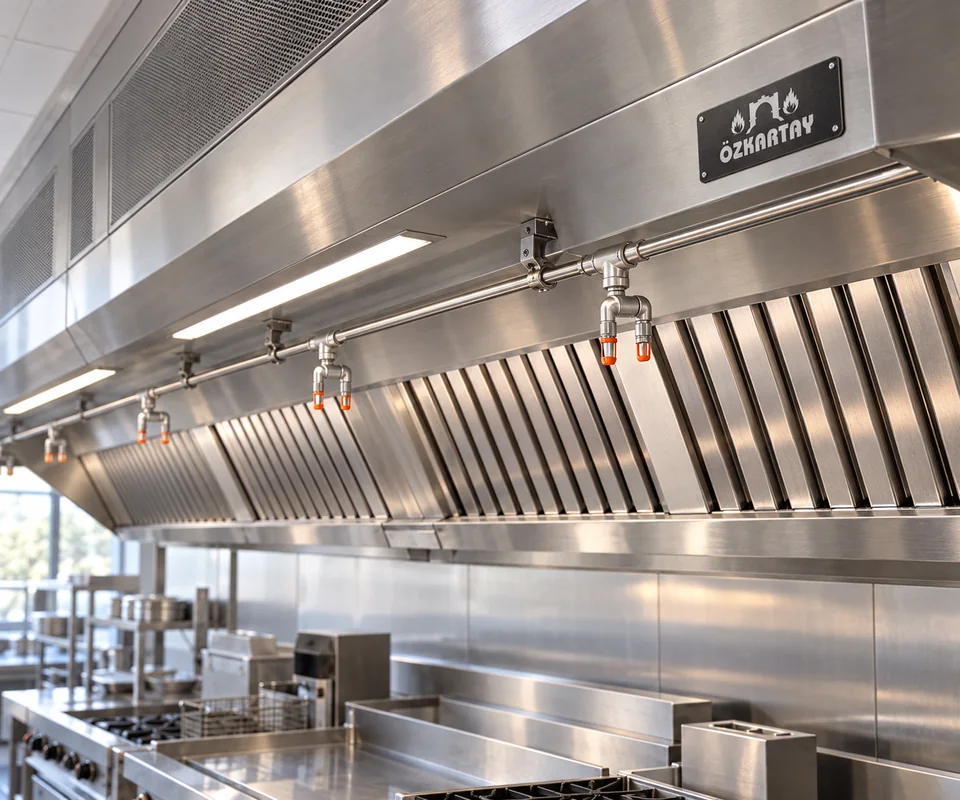
Detection elements in the hood and duct area identify the temperature rise associated with a fire. Depending on the selected system, fusible links or pneumatic detection tubes are used; detection and actuation are installed according to the relevant manufacturer instructions.
Chemical suppression and saponification
A liquid chemical suitable for cooking-oil fires is applied through dedicated nozzles to the protected surfaces. A suitable formulation containing potassium salts forms a protective layer on hot grease through saponification; cooling and vapour suppression help reduce the risk of re-ignition.
Fuel and energy shutdown
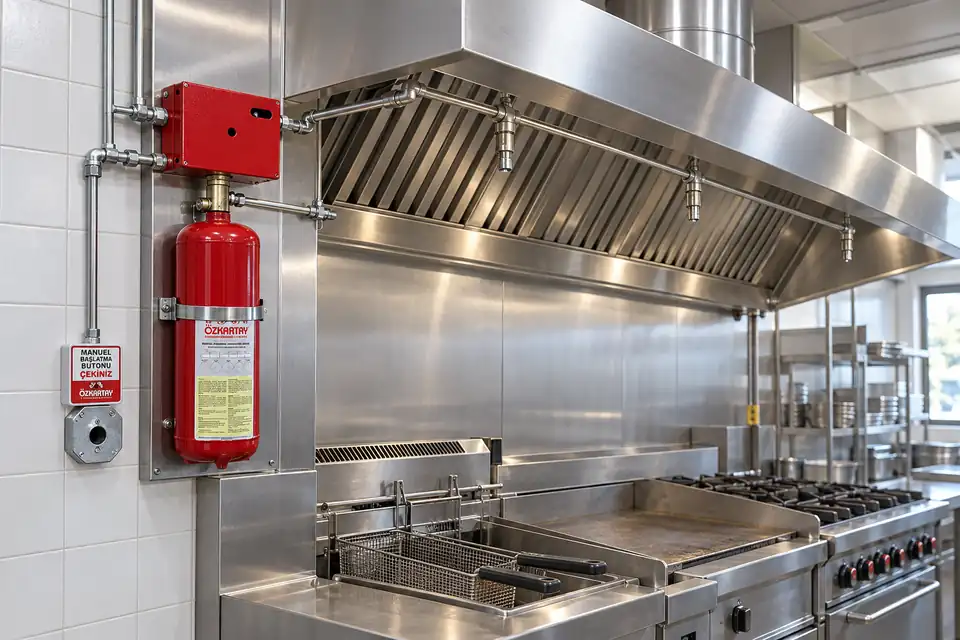
When the system operates, suitable interfaces shut off gas and electrical energy to the protected cooking appliances. Alarm reporting and ventilation operation are tested against the selected system sequence. Where gas-leak detection is included, it is designed as a function separate from suppression actuation.
02
Design and system scope
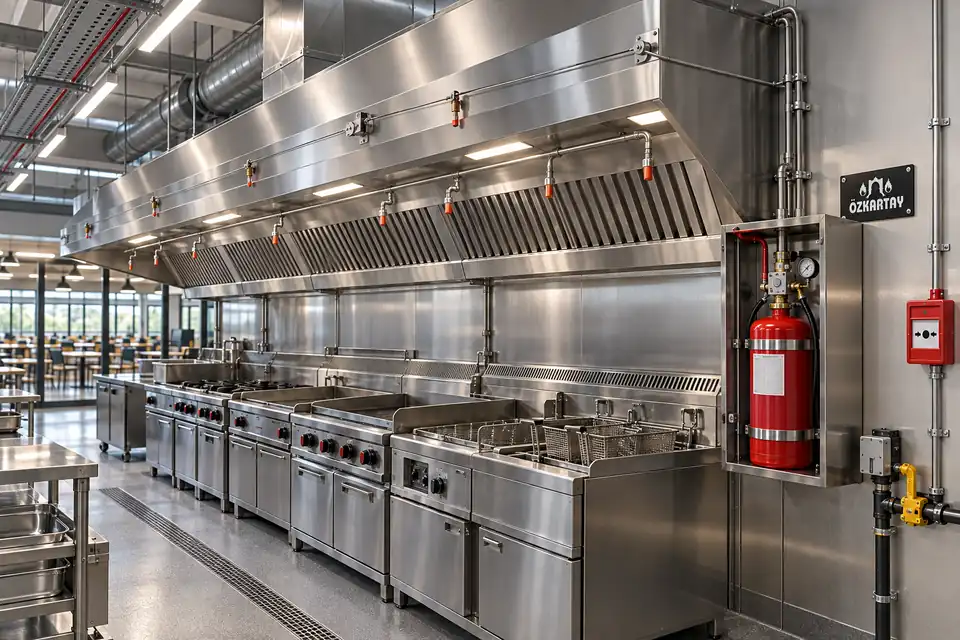
Hood, filter and duct dimensions, cooking appliances, agent quantity, nozzle placement, detection, gas shutdown, warning and periodic maintenance are assessed together.
Nozzle layout and agent selection
- Appliance-specific protection
- Suitable nozzle type, angle and height are selected for fryers, grills, cookers, plenums and ducts. Nozzle count, coverage and pipework limits are established from the manufacturer’s verified design data.
- Agent quantity and formulation
- Agent quantity and the selection of a potassium-carbonate-based formulation follow the protected appliances and system scope. A low-pH description is formulation-specific; the actual pH and material compatibility are verified from the selected product’s technical data.
Detection temperature and manual release
- Fusible-link rating and detector position
- Fusible-link temperature ratings are selected with regard to normal cooking temperatures and manufacturer instructions. Detection elements are positioned in the hood and duct to detect fire conditions while reducing unwanted actuation during normal operation.
- Accessible manual pull station
- The manual release is positioned so staff can reach it without approaching the hazard, in coordination with the escape arrangement. Its location, identification and operation are addressed through the selected system instructions and site training.
Integration, testing and maintenance
- Ventilation sequence
- Gas and electrical shutdown are assessed separately from exhaust and supply-air fans. Shutting down every fan is not a general rule; suitable arrangements can retain exhaust operation while stopping supply air. Final operation follows manufacturer instructions and the approved design.
- Site verification and periodic maintenance
- Detection, manual release, shutdown interfaces and warning functions are tested according to the instructions. Clear nozzles, maintained appliance positions, grease cleaning and system servicing are planned together; protection is reassessed whenever the kitchen layout changes.
03
Applications by kitchen type
Protection is shaped by the cooking appliances and hood/duct arrangement rather than the business category alone. The following examples are assessed during the site survey and design.
Restaurant and hotel kitchens
- Kitchen conditions
- Intensive fryer, grill and cooker use, varying service demand and different appliance layouts.
- Application approach
- Cooking-surface protection is designed together with hood, plenum and duct coverage. Appliance-compatible nozzles, accessible manual release and cooking-energy shutdown interfaces are planned.
Hospitals, schools and canteens
- Kitchen conditions
- Bulk meal preparation, scheduled service periods and kitchens serving different occupant groups.
- Application approach
- Appliance and duct coverage is established, with staff warning, manual release arrangements and any required building-alarm interfaces planned together. Testing, user training and maintenance records are coordinated with operating schedules.
Shopping-centre and airport food outlets
- Kitchen conditions
- Commercial kitchens operating among multiple tenants, shared building systems and high visitor traffic.
- Application approach
- Each kitchen’s protection boundaries and shared duct connections are assessed. Suppression reporting, gas/electrical shutdown and ventilation operation are coordinated with building management and the relevant disciplines.
Catering and industrial kitchens
- Kitchen conditions
- High production volumes, long cooking lines and processes that generate substantial grease-laden vapour.
- Application approach
- Appliances, hoods and duct geometry are surveyed along the cooking line, with agent quantity, pipework and discharge coverage defined within manufacturer limits. Access is planned for cleaning, servicing and appliance changes.
04
Kitchen hood suppression system overview
Scroll the table horizontally to view every column.
| Parameter | Feature / project assessment |
|---|---|
| Fire class | Cooking oils and fats: Class K or F under the applicable classification system |
| Suppression agent | Potassium-carbonate-based liquid chemical suitable for cooking-grease fires; formulation and pH depend on the selected product |
| Protected areas | Cooking surfaces, plenums, hoods and exhaust ducts within the project scope |
| Interfaces | Gas/electrical shutdown to protected appliances, warning and manufacturer-compatible exhaust/supply-air operation |
| Kitchen types | Restaurants, hotels, hospitals, shopping centres, airports, schools, canteens, catering and industrial kitchens |
Coverage is verified against appliance type and placement, hood/duct dimensions and the selected system’s design instructions. Agent quantity, detection temperature, nozzle position and ventilation operation are established together for each kitchen.
Kitchen hood suppression helps reduce fire escalation through suitable detection, appliance-specific agent discharge, cooking-energy shutdown and regular maintenance. Özkartay plans these steps around actual kitchen use, from survey and design to site testing and commissioning.