
Skip to content

6 LT AFFF, AFFF-AR, synthetic or fluorine-free (NFF / F3) foam ceiling-type extinguisher

6 LT AFFF, AFFF-AR, synthetic or fluorine-free (NFF / F3) foam ceiling-type extinguisher

About the product

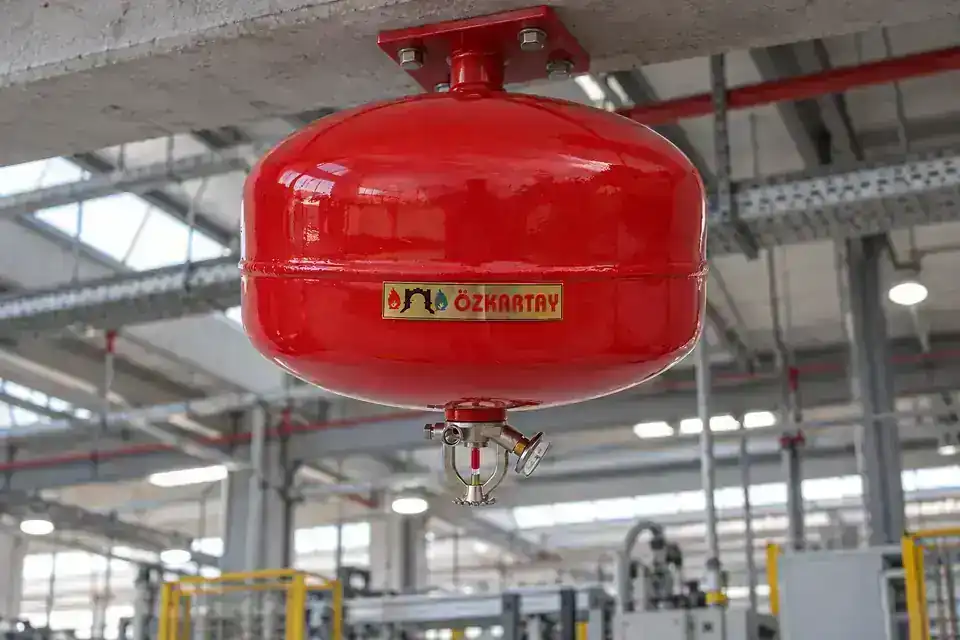
6 LT AFFF, AFFF-AR, synthetic or fluorine-free (NFF / F3) foam ceiling device; fitted with a sprinkler head that activates at 68, 93 or 141 °C according to the environment.

Explore ceiling components and how they work
Brand
Özkartay
Capacity
6 LT
Extinguishing agent
AFFF, AFFF-AR, synthetic or fluorine-free (NFF / F3) foam

Product features

  1. Brand: Özkartay
  2. Extinguishing agent: AFFF, AFFF-AR, synthetic or fluorine-free (NFF / F3) foam
  3. 6 LT extinguishing-agent capacity; fixed ceiling device
  4. Forms a foam blanket over flammable-liquid surfaces; concentrate and proportioning are selected for fuel and device compatibility.
  5. 85 micron electrostatic powder coating
  6. 18 bar operating pressure; 25 bar test pressure
  7. Sprinklers operating at 68, 93 or 141 °C depending on the environment
  8. Fixed ceiling mounting; agent, mounting orientation and fire risk of the protected area are assessed together

Frequently asked questions

Which fires are foam fire extinguishers used for?

They are mainly used for flammable-liquid fires and suitable oil/liquid risks. The fire class, foam type and application method should be selected by a qualified assessment.

How is the ceiling device activated?

The sprinkler head’s thermal glass bulb contains a special heat-expanding liquid. A head rated at 68, 93 or 141 °C is selected according to the environment; when the bulb breaks at its activation temperature, the sealed outlet is released and agent discharges through the head. Mounting follows the selected device technical instructions.

How are AFFF, AFFF-AR, synthetic and fluorine-free (NFF / F3) foam options selected?

Select the concentrate against the fuel, fire class, environmental conditions and device specifications. Proportioning follows the selected concentrate technical data sheet and device compatibility; one ratio does not apply to every foam option.

Does foam require clean-up after discharge?

Cleaning and post-use collection depend on the selected foam agent and application. Follow the safety data sheet and manufacturer instructions for the AFFF, AFFF-AR, synthetic or fluorine-free (NFF / F3) option; fluorine-free does not by itself mean residue-free.

How often should foam extinguishers be maintained?

Fire extinguishers should be inspected by a qualified team at least once a year. For foam units, refill, leak-tightness, pressure and body/label condition should be checked and recorded together.

How are ceiling-type and different-capacity models selected?

Capacity, mounting orientation and placement are selected for the protected volume, access, expected fire type and site conditions. Each model’s capacity unit, mounting arrangement and application scope are assessed with its own product record and technical documentation.

INSIDE THE CEILING UNIT

Detects heat, discharges downwards.

A ceiling extinguisher carries its agent in its own vessel. Explore the body, ceiling mount and heat-sensitive discharge head separately. This mechanical guide is representative; powder and foam models can differ in agent and head arrangement.

A ceiling extinguisher secured by a top plate, with a wide rounded red vessel and a heat-sensitive head underneath.
Supporting mount above, heat-sensitive discharge head below.

Why a wide body and a head underneath?

A wide, shallow vessel provides a compact ceiling arrangement. Its rounded form relates to pressure-vessel construction. The lower head is exposed to rising heat and directs agent towards the protected area; the actual distribution is established through model-specific testing.

How does it work?

  1. Heat reaches the head

    The thermal element responds to a temperature rise around it; it does not operate as a smoke detector.

  2. The sealed outlet is released

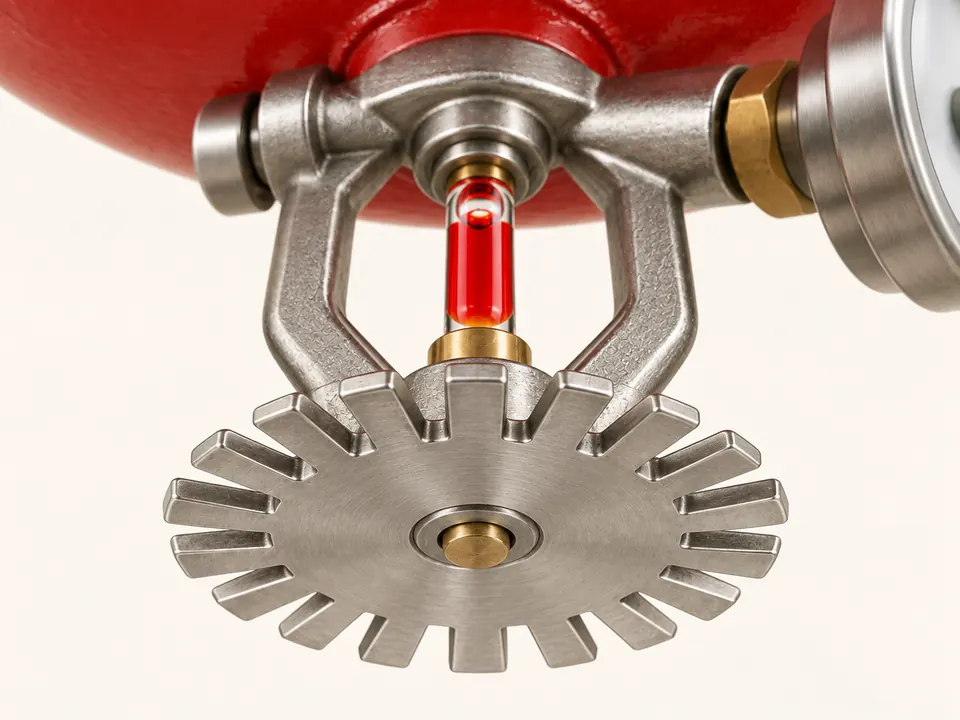
    The special liquid inside the thermal glass bulb expands with heat. A red bulb has a nominal activation temperature of 68 °C; the broken bulb releases the outlet.

  3. Agent is distributed

    Vessel pressure drives agent through the discharge head. The outlet and deflector shape the direction of the flow.

ABC powder options

The vessel contains dry chemical powder. Powder composition, charge quantity and discharge arrangement are assessed with the selected product’s technical information.

Foam options

The vessel contains a foam extinguishing solution suitable for the model. Foam blanketing and water-based cooling depend on the agent; the head need not be identical to a powder model’s.

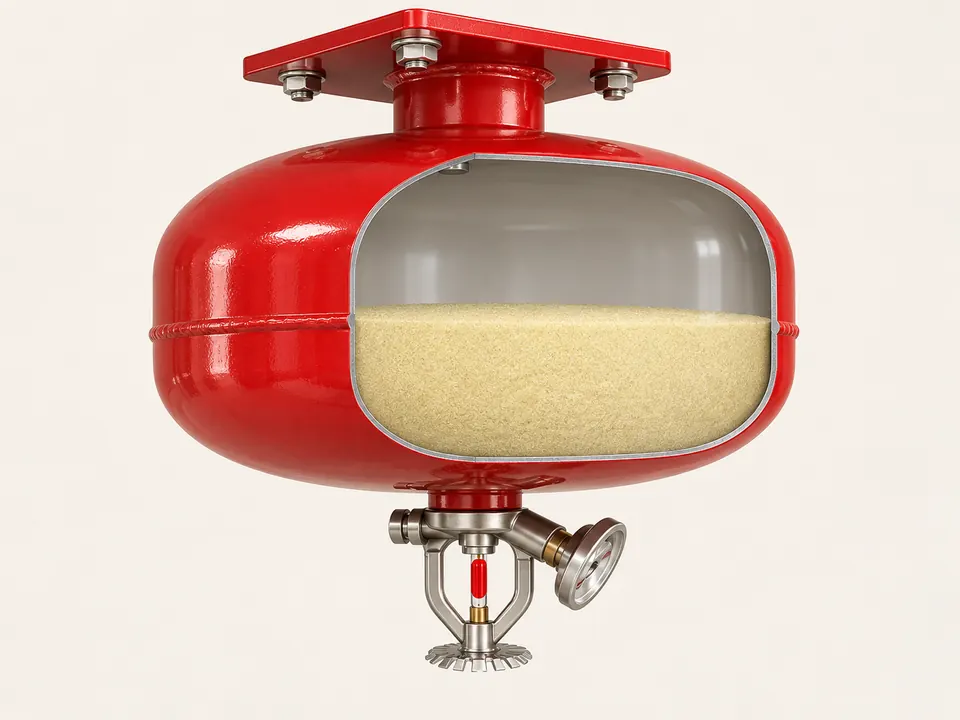
Schematic cutaway of a red ceiling vessel with light-coloured powder below, gas space above and a discharge head underneath.

Schematic ABC powder example; internal geometry and fill level are not to scale.

Vessel and contents

In a stored-pressure example, the vessel contains agent and propellant gas. The cutaway schematically illustrates an ABC powder example.

Why this shape or arrangement?
The shallow, wide, rounded vessel suits a ceiling arrangement; its shape alone does not indicate capacity or pressure.
What matters when selecting the component?
Vessel integrity, coating, a model-compatible charge and documented vessel tests.
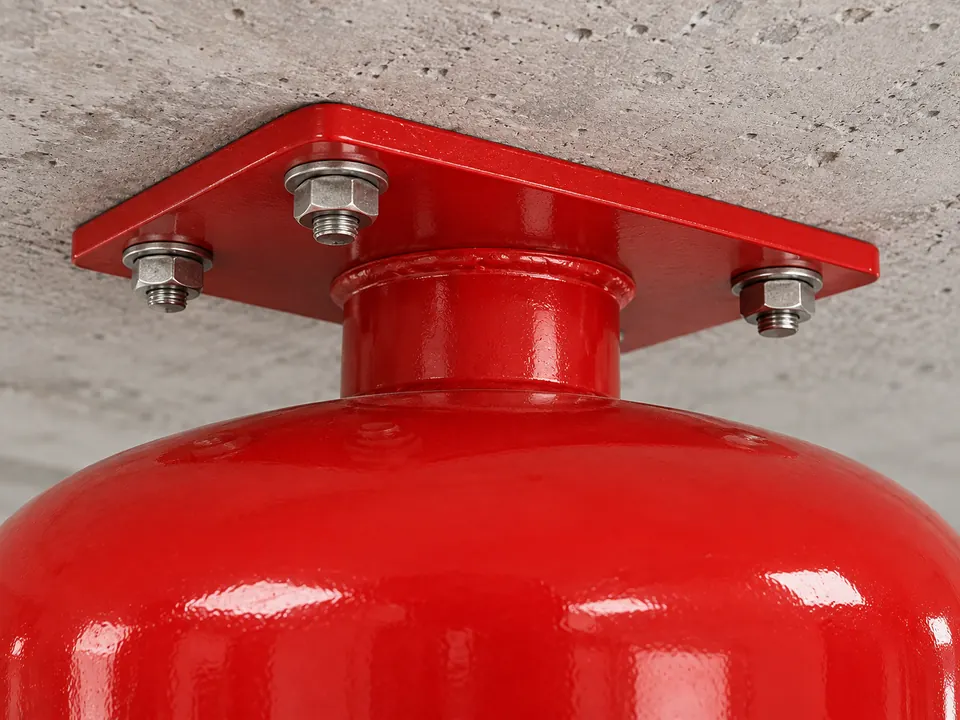
Representative close view of a red mounting plate secured beneath concrete with four fixings and the unit’s upper neck connection.

Representative component illustration

Ceiling plate and supporting connection

The upper plate transfers the unit’s weight to the mounting surface. The neck and connections support the vessel below the plate.

Why this shape or arrangement?
The plate’s fixing points spread the load into the mounting surface. Supporting the unit from above leaves its lower discharge head exposed.
What matters when selecting the component?
The supporting surface, appropriate fasteners and the mounting position specified for the product.
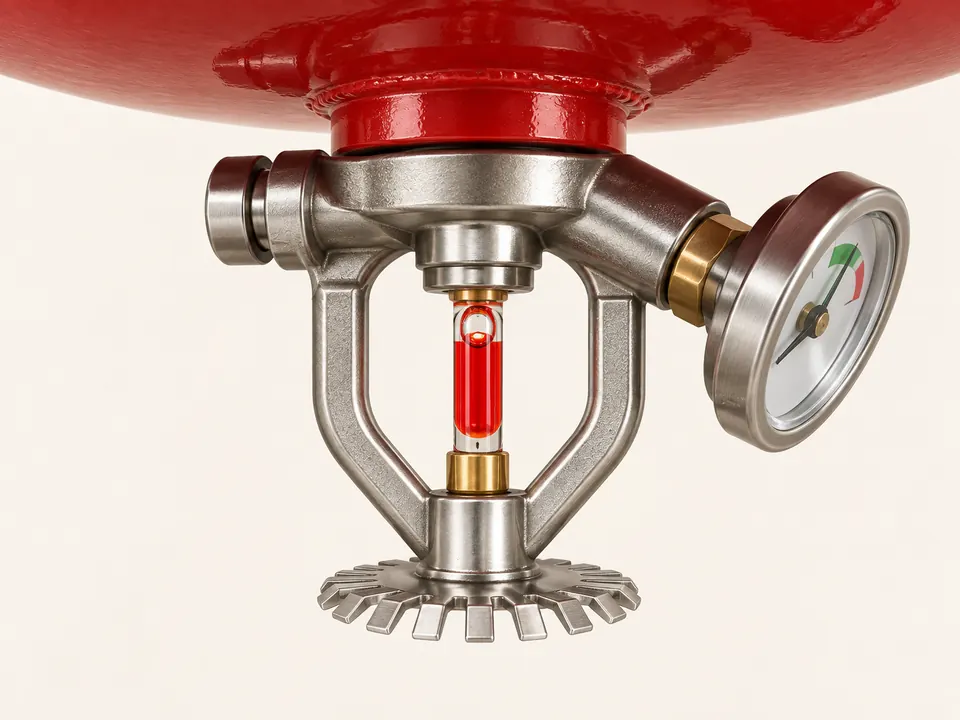
Representative ceiling head with an intact glass bulb inside a metal frame, sealed outlet above and deflector below.

Representative component illustration

Heat-sensitive release element

This component is a thermal glass bulb. Its special heat-sensitive liquid expands to break the bulb and open the sealed outlet. A red liquid-filled bulb has a nominal activation temperature of 68 °C.

Why this shape or arrangement?
The slender, exposed bulb is subject to surrounding heat. The metal frame aligns the bulb with the outlet assembly.
What matters when selecting the component?
An undamaged bulb and a model-compatible thermal element. Activation temperature is verified from the head and product data sheet.
Representative underside close view of a ceiling extinguisher’s metal deflector plate and head frame.

Representative component illustration

Outlet and distribution head

Agent leaving the open outlet is directed by the head geometry. In an example with a deflector plate, the plate helps spread the flow.

Why this shape or arrangement?
The plate’s edge shape affects flow direction. Protected area cannot be calculated from the plate’s appearance or the vessel diameter alone.
What matters when selecting the component?
An unobstructed outlet, undamaged head and a distribution arrangement verified for the selected agent.

Design and installation guide

6 LT AFFF, AFFF-AR, synthetic or fluorine-free (NFF / F3) foam ceiling-type extinguisher: selection and application guide

Foam ceiling devices provide fixed local protection with automatic discharge through a heat-sensitive head. Select AFFF, AFFF-AR, synthetic or fluorine-free (NFF / F3) concentrate by assessing fuel chemistry, device specifications, mounting position and the discharge path together.

6 LT foam fire extinguisher considered for first response to flammable-liquid fires. The AFFF, AFFF-AR, synthetic or fluorine-free (NFF / F3) foam selection and proportioning are confirmed from the facility fire risk and protected materials.

01

Selection, placement and maintenance

Selection considers the product function, the protected risk and operating conditions together. These steps support the site survey and quotation.

  1. Fuel and concentrate compatibility

    Hydrocarbon and water-miscible polar fuels require different assessments. Check the concentrate and device pairing where alcohol resistance is needed; do not assume general suitability for live electrical equipment.

  2. Mounting position and local protection

    Determine mounting height, activation element and the discharge path to the protected equipment from the chosen model documentation. A ceiling-mounted device is not a substitute for a designed building sprinkler or detection system.

  3. Activation arrangement and service access

    Assess automatic discharge against manufacturer instructions and the facility alarm and operating plan. Keep the discharge path clear and allow access for inspection and replacement.

  4. Head, pressure and fixed-mounting checks

    Inspect the vessel, thermal glass bulb, fitted gauge, mounting hardware and discharge path together. Set inspection, servicing and recharge intervals from the selected fixed device instructions; arrange qualified service before returning a discharged, damaged or depressurised device to use.

02

Applications and site planning

These examples show why placement and equipment requirements can differ between facilities using the same product.

Production and storage areas

Site requirement
Stored materials, equipment and site movement can change together.
Application approach
Check overhead placement, clearances and service access against model data.

Spaces using flammable liquids

Site requirement
Fuel type and concentrate compatibility.
Application approach
Match the agent and device to polar or hydrocarbon fuel.

03

Pre-quotation checklist

Scroll the table horizontally to view every column.

Pre-quotation checklist
Check itemProduct / applicationInformation to assess
Capacity6 LTAgent quantity, assessed with fire rating and placement
Extinguishing agentAFFF, AFFF-AR, synthetic or fluorine-free (NFF / F3) foam; selected product scopeLabel, fuel and use conditions
ArrangementCeiling-mounted local protectionModel mounting and activation conditions
MaintenanceService against model instructionsBody, charge and discharge hardware

Suitable selection matches capacity, agent and arrangement to the actual facility risk. We can assess survey, placement and servicing together to define this product’s role in your operation.