
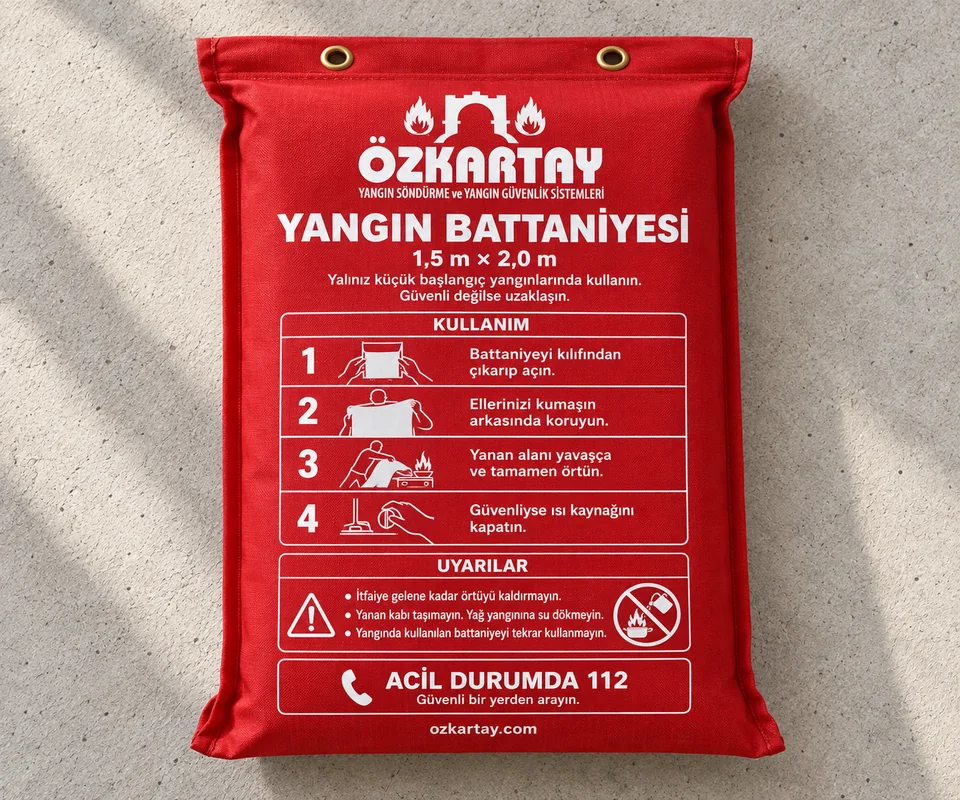
 Fire blanket
Safety equipment and fire blankets
Personal protective equipment, fire blankets and safety signage.
Explore the design and installation guide
Catalogue options
Products
Fire blanketDesign and installation guide
Fire blankets: accessible equipment and safe first-response preparation
A fire blanket can help cover a small fire at an early stage within the product’s application limits. Equipment provision is considered together with a safe escape route and correct alarm response.
Select the fire blanket offered in this group around the space, product dimensions, label instructions and personnel training. A blanket supports the facility’s fixed protection and emergency plan.
01
Selection and preparation for use
Preparation extends from selecting equipment to keeping it accessible and understandable.
Check the product scope
Check dimensions, material, applications and documentation for the selected product. Do not assume all blankets have the same fire rating or protective performance.
Position and access
Position the case where it is visible and reachable. Avoid a location requiring approach to the fire to retrieve it, and keep escape access clear.
Personnel preparation
Brief staff on label instructions and the facility’s response limits. Demonstrate removal from the case and equipment familiarisation in controlled training.
Understand the response limit
Consider only small, early-stage incidents that can be approached safely. Dense smoke, growing flames or a blocked escape route call for alarm and evacuation.
Checks and action after use
Regularly inspect the case, pull tabs, instructions and material condition. Replace a used or damaged blanket according to manufacturer instructions before returning the point to service, and record the incident.
02
Preparation by application
Assess product suitability and personnel response together.
Kitchens and food-preparation areas
- Need
- Equipment for a suitable small incident and a clear escape route.
- Preparation approach
- Check kitchen applications in the instructions. Keep the case accessible away from the cooker, and plan suitable hood and suppression protection for commercial cooking risks.
Workshops and laboratories
- Need
- Varied materials and process hazards.
- Preparation approach
- Match the blanket’s limited scope to the hazard inventory. Select equipment separately for chemical, electrical and special metal risks.
Offices and staff amenity areas
- Need
- Users who know equipment locations and alarm procedures.
- Preparation approach
- Provide a visible position, clear instructions and staff briefings, maintaining access during normal operations.
Training and drill preparation
- Need
- Understanding when to intervene and when to evacuate.
- Preparation approach
- Build scenarios around maintaining escape and recognising when to stop intervention. Bound training to participants’ roles.
03
Fire blanket readiness checks
Scroll the table horizontally to view every column.
| Check | Item reviewed | Expected outcome |
|---|---|---|
| Product suitability | Dimensions and label scope | Selection matched to the hazard |
| Position | Access and escape route | Retrieval without approaching the fire |
| User readiness | Instructions and training | Understanding response limits |
| After use | Damage and incident record | Replacement according to instructions |
Follow manufacturer instructions and the facility’s emergency procedure. If intervention is unsafe, leave, raise the alarm and call professional assistance.
Fire blanket readiness combines the right product, clear access and users who understand its limits. Coordinate positioning and training with the facility’s wider fire-safety plan.