
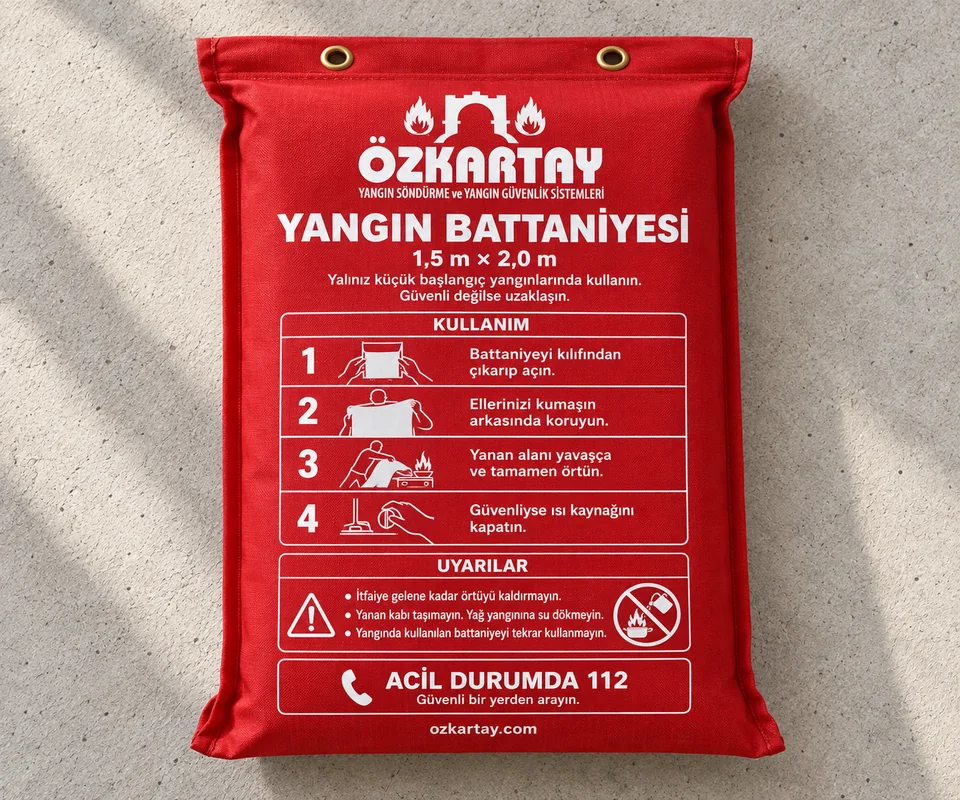
Design and installation guide
Fire blanket: selection and application guide
A fire blanket is assessed for suitable small incipient fires by covering the flame and limiting contact with air. Selection considers fire size, location, blanket dimensions and the selected model use scope.
First-response equipment for small, incipient fires—especially kitchen/oil and limited flammable-liquid risks—that helps reduce oxygen contact by covering the flames. It should only be used when the escape route is clear and intervention is safe.
01
Selection, placement and maintenance
Selection considers the product function, the protected risk and operating conditions together. These steps support the site survey and quotation.
Hazard and size compatibility
Check suitability and dimensions capable of fully covering the fire against product documentation. Do not assume every blanket has the same heat resistance or industrial-use scope.
Accessible storage
Keep the container visible and accessible. Do not place it where reaching it requires passing through the hazard, and keep the escape route clear.
Training and response limits
Limit use to a small incipient incident by someone familiar with the instructions and able to escape safely. Evacuation and emergency assistance take priority with growing fire or heavy smoke.
Condition checks and replacement
Check the container and access arrangement; assess condition after use, contamination or damage against manufacturer instructions. Do not assume a used blanket is automatically fit for reuse.
02
Applications and site planning
These examples show why placement and equipment requirements can differ between facilities using the same product.
Suitable kitchen and service areas
- Site requirement
- Safe access for small incipient incidents.
- Application approach
- Select the model scope and storage location with the hazard point and escape route.
Training and initial-response planning
- Site requirement
- Personnel familiarity with product instructions.
- Application approach
- Explain use and when to stop intervention during training, and plan the blanket with other fire-safety equipment.
03
Pre-quotation checklist
Scroll the table horizontally to view every column.
| Check item | Product / application | Information to assess |
|---|---|---|
| Model scope | Use scope stated by the manufacturer | Fire type, material and size |
| Placement | Visible and accessible container | Safe access and clear escape route |
| Use | Suitable small incipient incident | Instructions, training and response limits |
| Inspection | Container and product condition | Replacement assessment after damage or use |
Plan a suitable fire blanket, its location and access by people familiar with its use together. Space and hazard information allow us to establish selection and placement scope.