
Design and installation guide
Dry-pipe sprinkler system: selection and application guide
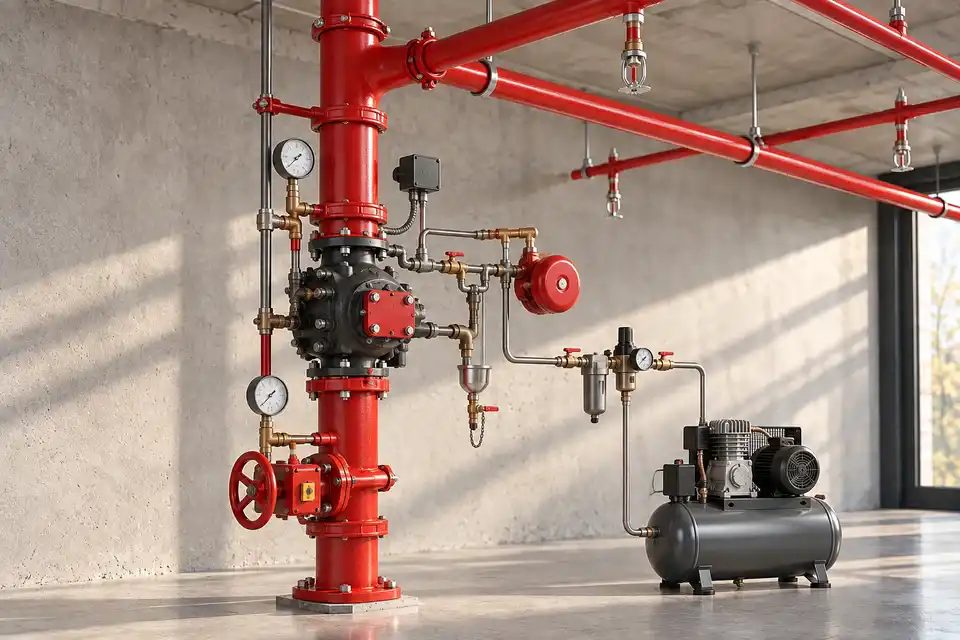
In a dry-pipe arrangement, the pipe network is normally supervised with compressed air or the selected gas. Pressure changes after a sprinkler opens cause the dry valve to admit water. This is one option assessed for spaces exposed to freezing.
A dry-pipe sprinkler system keeps the downstream pipe network filled with pressurised air or nitrogen until a sprinkler opens. The pressure drop opens the valve and water then travels to the fire area. It is considered for cold stores, open car parks and similar areas exposed to freezing.
01
Operating arrangement and engineering
Selection considers the product function, the protected risk and operating conditions together. These steps support the site survey and quotation.
Dry valve and air supply
Select the valve, air/gas supply and supervision equipment together. Check water delivery against pipe volume and the calculation conditions for the arrangement.
Drainage and freeze management
Include removal of trapped water and low points in maintenance for exposed piping. Plan freeze protection for the valve space and water-filled sections separately.
Hydraulic calculations and layout
Calculate hazard classification, storage or process data, pipe sizes and water demand at the critical point together. Pump, tank and head/nozzle selection are elements of this design.
Testing and maintenance
Verify water supply, valve/alarm functions and the relevant system scenario during commissioning. Record system-specific testing and maintenance tasks in operating records.
02
Applications and site planning
These examples show why placement and equipment requirements can differ between facilities using the same product.
Unheated warehouse sections
- Site requirement
- Freezing exposure and changing storage layouts.
- Application approach
- Design for freezing conditions, water delivery and drainage points together.
Suitable cold-exposed spaces
- Site requirement
- Ambient temperature and service access.
- Application approach
- Assess valve location, supervision equipment and trapped-water points with the operating plan.
03
Pre-quotation checklist
Scroll the table horizontally to view every column.
| Check item | Product / application | Information to assess |
|---|---|---|
| System arrangement | Air/gas-supervised piping and dry valve | Design diagram and operating scenario |
| Water supply | Pump, tank and pipe network | Hydraulic demand and available supply |
| Space | Fire hazard and environmental conditions | Storage, temperature and obstructions |
| Handover and maintenance | Function tests and records | System-specific inspection plan |
Select the sprinkler arrangement through a combined assessment of hazard, environment and water supply. Survey and engineering calculations establish its layout, equipment and operating scope.