
Design and installation guide
Inert-gas suppression systems for sensitive and critical areas
Inert-gas systems control fire by reducing oxygen in a suitable enclosure to the designed suppression condition. Systems using nitrogen, argon or their mixtures offer an electrically non-conductive option without extinguishing-agent residue.
Agent, required concentration, enclosure integrity, pressure management and occupancy are assessed together. Design provisions under ISO 14520, EN 15004 or NFPA 2001 are applied to the selected system. Natural gas constituents alone do not make every concentration safe or the complete life cycle environmentally impact-free.
01
Total-flooding protection and the operating sequence
Detection, warning, evacuation and discharge are coordinated with use of the protected enclosure.
Detection and release control
Detection confirmation, audible and visual warnings, any required delay, manual controls and ventilation shutdown are defined in the project. Door closure and associated equipment shutdown help retain the agent within the protected enclosure.
Reducing oxygen concentration
The approximately 21% oxygen in normal air is reduced by the calculated agent quantity to a design level that does not sustain the fire. Required concentration follows the fuel and the system’s test and documentation scope; one 12–14% range is not applied to every hazard or enclosure.
Occupancy and exposure conditions
Personnel safety is assessed from concentration, exposure duration, altitude, occupancy and the applicable standard’s limits. CO₂ within IG-541 does not remove the need for evacuation. Re-entry and ventilation after discharge are managed under the emergency plan.
Residue-free protection and environmental assessment
Inert agents leave no extinguishing residue, and environmental indicators for the selected gas are assessed using manufacturer documentation. Life-cycle effects of supply, high-pressure storage, refilling, transport and maintenance are also considered.
02
Agent options, mechanical arrangements and room integrity
Agent compositions differ, and cylinders, piping and nozzles are selected using the engineering calculations for each system.
Inert-gas compositions
- IG-01: argon
- IG-01 consists of 100% argon. Gas density, enclosure geometry and openings are assessed together; its greater density does not imply automatic penetration into sealed or separate spaces.
- IG-100: nitrogen
- IG-100 consists of 100% nitrogen. Distribution and retention conditions are calculated with the selected nozzles and enclosure integrity.
- IG-55: nitrogen and argon
- IG-55 nominally contains 50% nitrogen and 50% argon. Quantity and discharge arrangements are established for the fuel, temperature and protected volume.
- IG-541 / INERGEN
- IG-541 nominally contains 52% nitrogen, 40% argon and 8% carbon dioxide. INERGEN is a manufacturer brand associated with this blend. Occupancy is checked against concentration and exposure limits as it is for other agents.
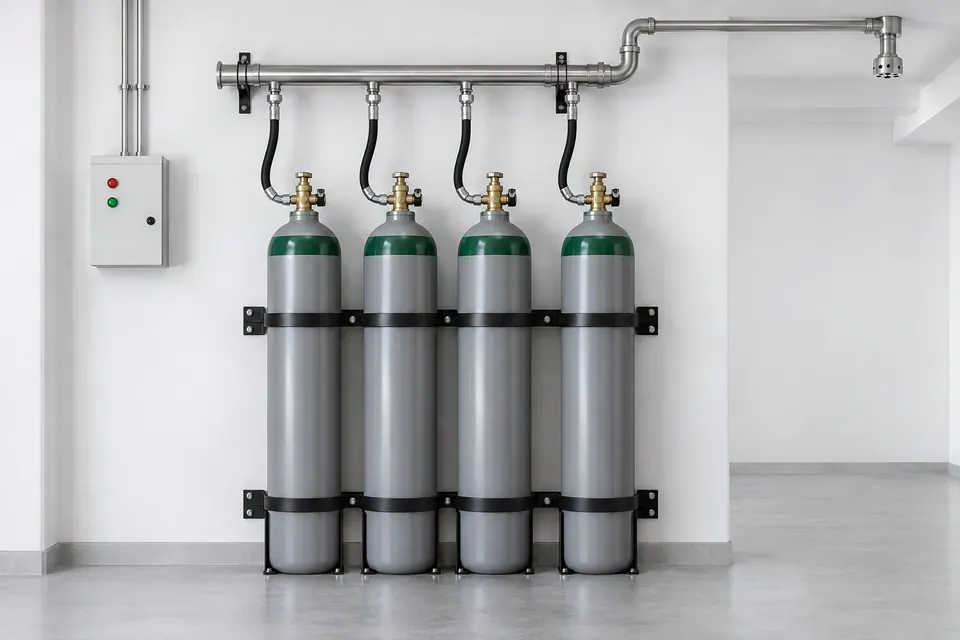
Cylinders, manifold and distribution
- High-pressure cylinder bank
- Storage options such as 200 or 300 bar depend on the selected system’s documented cylinders and valves. Cylinder volume, quantity, ambient temperature and room area are calculated; a fixed space-saving percentage is not promised for higher pressure.
- Manifold and pressure management
- Cylinders connect to the distribution line through suitable connections and a manifold. The role of a regulator, orifice or constant-pressure arrangement depends on the selected technology. Cylinder storage pressure and distribution-line design pressure are checked separately.
- Piping, nozzles and acoustic effects
- Pipe pressure rating, connection type, line length and nozzle orifices follow manufacturer flow calculations. Nozzle direction and acoustic effects are assessed with sensitive equipment; one pipe length or line pressure is not applied to every system.
Enclosure integrity, tests and maintenance
- Door Fan test and hold time
- A fan-based integrity test helps assess concentration retention from enclosure leakage characteristics. Required hold time, protection height and the acceptance method follow the adopted standard and design basis and are reassessed after changes to doors or services.
- Pressure-relief arrangement
- Pressure differences during discharge are calculated using wall and ceiling strength and the vent route. Any required relief damper and opening are sized for discharge flow and enclosure conditions; one discharge duration is not assumed for every system.
- Commissioning and operational checks
- Detection, alarms, ventilation and release interfaces are verified through controlled tests. Agent quantity and fill condition, valves, hoses, nozzles and enclosure changes are checked under the manufacturer programme. A full gas discharge is not assumed to be the only mandatory method of routine inspection.
03
Applications in sensitive enclosures
The need for residue-free suppression, enclosure closability and occupancy are assessed together.
Data centres and server rooms
- Protection requirement
- Electronic equipment, business continuity and acoustic sensitivity.
- Design approach
- Agent quantity, nozzle placement, acoustic options and ventilation shutdown are calculated together.
Museums, archives and art spaces
- Protection requirement
- Assets sensitive to wetting and extinguishing residue.
- Design approach
- Enclosure integrity, combustible materials and asset preservation are assessed; agent and design limits for deep-seated materials are checked separately.
Electrical and control rooms
- Protection requirement
- The need for a non-conductive agent and equipment isolation.
- Design approach
- Cable penetrations, enclosure openings and electrical shutdown functions are coordinated with the design.
Pharmaceutical and medical-device production areas
- Protection requirement
- Process conditions and sensitivity to residue.
- Design approach
- Cleanliness, process ventilation, occupancy and restart requirements are assessed in the project.
04
Compare inert-gas compositions
Scroll the table horizontally to view every column.
| Item | IG-01 | IG-100 | IG-55 | IG-541 |
|---|---|---|---|---|
| Nominal composition | 100% argon | 100% nitrogen | 50% nitrogen / 50% argon | 52% nitrogen / 40% argon / 8% CO₂ |
| Design concentration | Calculated for the fuel and system documentation. | Calculated for the fuel and system documentation. | Calculated for the fuel and system documentation. | Calculated for the fuel and system documentation. |
| Occupancy | Subject to concentration and exposure limits. | Subject to concentration and exposure limits. | Subject to concentration and exposure limits. | Relevant limits are checked including the CO₂ content. |
| Storage and distribution | Depends on selected-system pressure and flow calculations. | Depends on selected-system pressure and flow calculations. | Depends on selected-system pressure and flow calculations. | Depends on selected-system pressure and flow calculations. |
The composition table identifies agent families; it is not a safety ranking or certification declaration for an individual Özkartay product.
Share the enclosure dimensions, use and existing ventilation with Özkartay so agent, cylinder and room-integrity requirements can be assessed together.