
Design and installation guide
Room integrity testing: assessing agent retention within the protected enclosure
A gaseous suppression system is designed to establish and maintain the required agent concentration. Cable penetrations, door gaps, ventilation ducts and underfloor openings can affect retention. Verifying the enclosure boundaries matters alongside selecting the correct agent quantity.
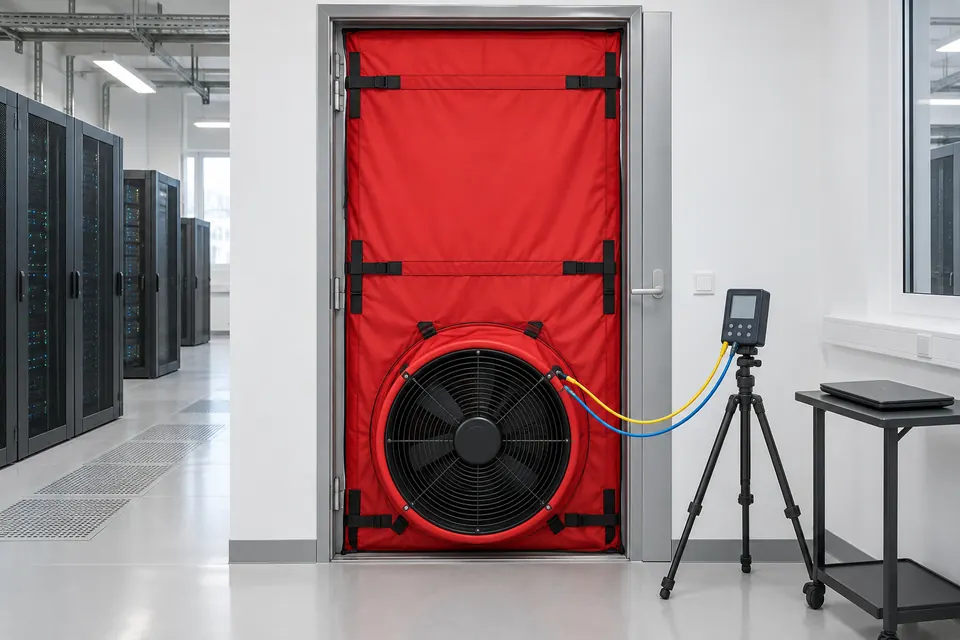
A Door Fan test measures enclosure air leakage using a temporary door-panel fan and calibrated pressure instruments. Measurements support calculation of equivalent leakage area and predicted agent retention under the design conditions. It is a measurement-based prediction rather than an actual extinguishing-gas discharge.
01
Enclosure preparation, fan measurement and assessment
The measurement must represent the enclosure during suppression. Openings, dampers intended to close and protection height are defined before testing.
Define the protected boundary
Walls, doors, ceiling and floor boundaries are reviewed. The design establishes whether raised-floor and ceiling voids belong to the protected enclosure. Ventilation closure during discharge and openings that remain open are recorded.
Install fan and pressure instruments
A temporary panel and fan are installed in a suitable doorway. Pressure tubes are connected to the correct reference points. Instrument calibration, enclosure volume, temperature and background pressure differences are recorded.
Measure leakage behaviour
Airflow and pressure difference between the enclosure and its surroundings are measured at the test points required by the selected method. Pressurisation and depressurisation readings are evaluated with background-pressure correction. Equivalent leakage area is calculated from these measurements.
Retention prediction and reporting
Agent type, design concentration, protection height and leakage distribution inform the calculation. Predicted retention is compared with the acceptance criterion adopted for the project. Defects are corrected, required measurements repeated and results included in the handover report.
02
Integrity, pressure and operation are considered together
Reducing leakage supports retention, while the enclosure must also manage discharge pressure safely. These requirements are verified through separate assessments.
Calculation and acceptance
- Basis of the retention period
- Some design bases use a ten-minute target. Required duration and protected height depend on the agent, hazard, adopted standard and acceptance authority. One duration does not establish adequacy for every enclosure and gas.
- Measurement versus prediction
- The fan test directly measures airflow and pressure differences. Agent retention time is a model output using these measurements. The report identifies the method, leakage-distribution assumptions and enclosure data.
Openings and pressure relief
- Correcting leakage
- Penetrations, door seals and construction joints are improved using suitable methods. Firestopping must match a tested system for the construction and services. The fan test characterises total leakage rather than locating every concealed opening.
- Pressure relief arrangement
- Discharge pressure effects are calculated separately. Required vent area, opening pressure and relief route are coordinated with the protection design. A smaller leakage area does not remove the need to assess pressure relief.
Diagnostics and continued integrity
- Leakage diagnostics
- Suitable tracer smoke or airflow investigation can help locate accessible leaks. Methods and materials are assessed against equipment sensitivity and safety information, rather than applied unconditionally in every electronic environment.
- Operating and modification records
- New cable penetrations, door changes or ventilation alterations can affect verified boundaries. Inspection and any necessary retesting are planned. The result assesses enclosure integrity; it does not by itself certify a building or the complete suppression system.
03
Applications in sensitive enclosures
Enclosure geometry, equipment layout and operating conditions during discharge inform the test plan.
Data centres
- Enclosure condition
- Cable penetrations, raised floors and continuous ventilation may be present.
- Assessment
- Protected boundaries and closure sequences are defined, with testing conducted in the intended enclosure configuration.
Archives and critical-record rooms
- Enclosure condition
- Door use, shelving height and construction joints affect retention.
- Assessment
- Retention is assessed for the protection height and agent design, with suitable leakage improvements recorded.
Control and electrical rooms
- Enclosure condition
- Later service penetrations can change previously tested conditions.
- Assessment
- Site changes are tracked, with pressure relief, ventilation and retesting needs assessed together.
04
Complementary verification steps
Scroll the table horizontally to view every column.
| Item | Input | What does it show? |
|---|---|---|
| Fan measurement | Airflow, pressure differences and test conditions. | Measured enclosure leakage behaviour. |
| Retention calculation | Leakage data, agent, concentration and protection height. | Predicted duration under the design conditions. |
| Pressure relief calculation | Discharge flow, enclosure boundary and relief arrangement. | Pressure effects and required relief capacity. |
| Pipe leak testing | Piping and system-specific test method. | Piping and joint integrity; it does not measure room leakage. |
Share the agent type, enclosure geometry, protection height and ventilation sequence so we can define the measurement and reporting scope together.