
NFPA — membership record
The National Fire Protection Association membership certificate is included in our document records. The NFPA standards applicable to the project inform the testing and acceptance requirements for fire-protection systems.
We simulate the completed fire-protection and detection infrastructure on site against the facility’s emergency scenarios and design parameters. After verifying that all components work together, we prepare and deliver commissioning reports and acceptance records under the international standards and engineering guidance applicable to the project (NFPA/EN/FM/BS).
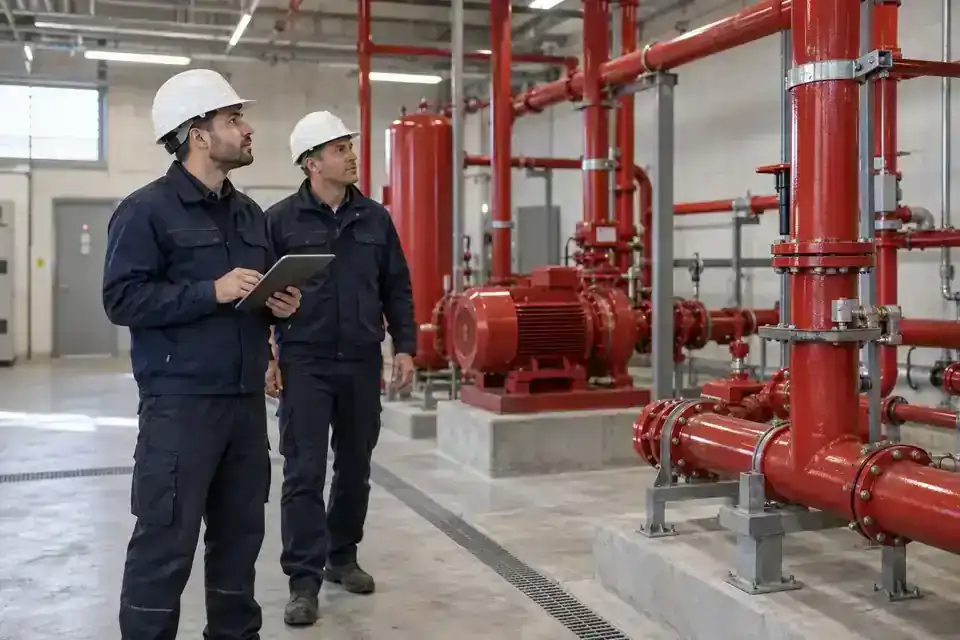
On-site verification
However carefully a fire safety system is designed and installed, its performance must be demonstrated through testing and commissioning. This process takes the installed systems beyond engineering calculations on paper and tests whether they can provide the intended protection in an emergency.
01
Commissioning checks more than whether a system operates. It also verifies its response to the agreed scenarios and its integration with other building systems:
The completed fire-protection and detection infrastructure is simulated on site to verify alignment with the facility’s emergency scenarios and design parameters.
A fire alarm or suppression system operating on its own is not sufficient. The integrated operation of all components is verified. Depending on the project’s emergency scenario, tests check that smoke detection stops air-handling units (HVAC), starts smoke-extraction fans, recalls lifts to the ground floor and releases access-control systems such as turnstiles and doors.
Calibrated instruments are used for fire-pump flow and pressure tests, water-flow checks at remote sprinkler points and smoke-detector sensitivity measurements.
Once integrated operation has been verified, the process is documented. Commissioning reports and acceptance records are prepared and delivered under the standards and engineering guidance applicable to the project.
02
Test procedures are defined by the project scope and the relevant standard requirements. You can review our NFPA membership record and EN/TSE product conformity documents, and access official FM and BS standards and engineering resources.
The National Fire Protection Association membership certificate is included in our document records. The NFPA standards applicable to the project inform the testing and acceptance requirements for fire-protection systems.
Our existing product documents for European standards include their scope and model details. These records include TS EN 16034 for the fire door and TS EN 671-1 for the fire hose cabinet.
FM Property Loss Prevention Data Sheets provide engineering guidance on preventing fire and property loss in industrial facilities. The relevant guidance is selected according to the facility’s risks and project requirements.
British Standards resources are available through BSI. Testing and commissioning requirements are considered for standards within the project scope, including detection and alarm systems.
Our TSE service qualification record 59-HYB-66 includes commissioning of fire suppression systems within the scope of TS 13905. View the TSE service qualification certificate
03
Different facility conditions require different test procedures and commissioning approaches:
Testing and commissioning, carried out with the NFPA, EN, FM and BS requirements applicable to the project, is the final critical stage in verifying fire safety scenarios on site. Measurement results, integration tests and acceptance records document the system for handover.